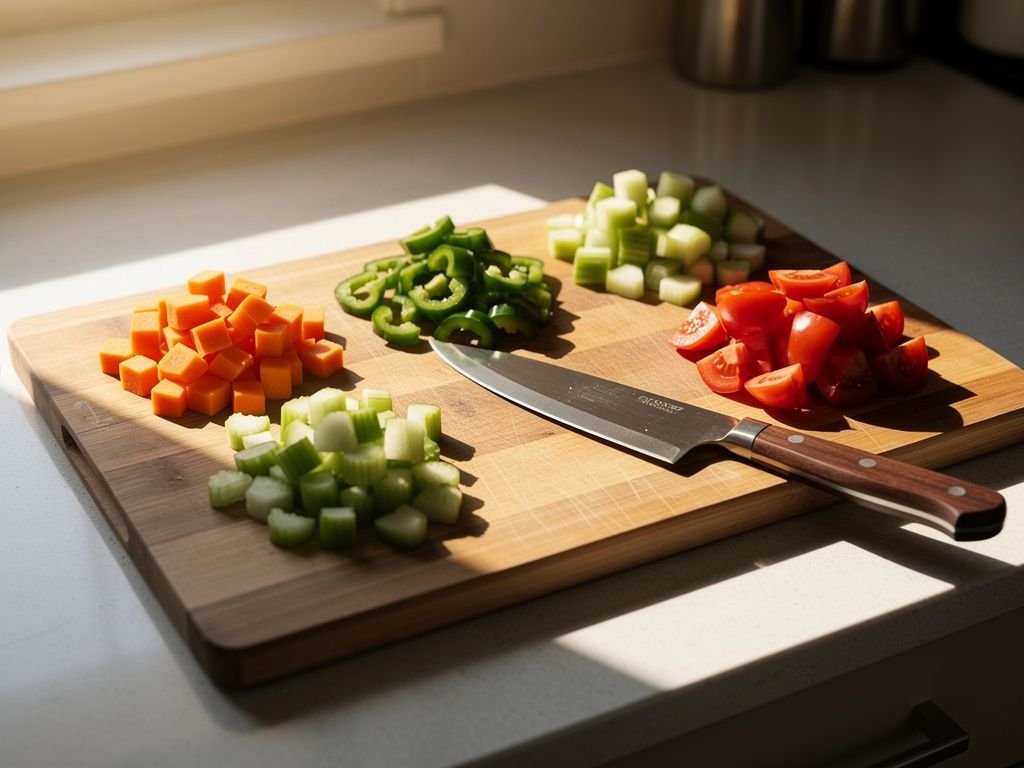
Ask any professional cook what separates a confident home cook from a frustrated one, and the answer is rarely a fancy gadget. It is knife skills. Once you can hold a knife correctly and execute a handful of basic cuts, everything else in the kitchen speeds up: vegetables cook more evenly, sauces thicken on schedule, and dinner stops feeling like a race against the clock.
Most beginners hold a knife by wrapping their whole hand around the handle, which actually reduces control. Instead, pinch the blade itself between your thumb and index finger, just above the handle, and let your remaining three fingers curl around the handle. This 'pinch grip' gives you far more precision and makes it easier to rock the blade through food. On your other hand, curl your fingertips under so your knuckles, not your fingertips, guide the blade. This is often called the 'claw grip,' and it is the single best habit for avoiding nicked fingers.
Practice the dice first. Cut an onion in half through the root, peel it, then make horizontal cuts parallel to the board (stopping short of the root end so the layers stay together), followed by vertical cuts, then crosswise cuts. The root end holds everything together while you work, which keeps your fingers away from the blade.
A dull knife is more dangerous than a sharp one because it requires more force and is more likely to slip. You do not need to be a sharpening expert to keep a blade usable. A honing steel, used before most cooking sessions, realigns the edge and keeps cuts clean between actual sharpenings. Plan to have your knives professionally sharpened, or learn to use a whetstone, every few months depending on how often you cook.
Wood and high-density plastic boards are kinder to your blade than glass, marble, or stone, which will dull an edge quickly no matter how careful your technique. Keep a damp towel or a rubber mat under your cutting board so it does not slide while you work. A board that shifts under pressure is one of the most common causes of kitchen cuts.
Speed is a byproduct of good form, not a goal in itself. When you are learning a new cut, slow down and focus on consistent sizing and a steady rocking motion rather than how fast you can move. As the motion becomes automatic, speed follows naturally. Many culinary students spend their first weeks of training just cutting onions and carrots into consistent dice, and there is a reason for that repetition: it builds muscle memory that pays off for the rest of your cooking life.
You do not need a special practice session to build these skills. Simply commit to using proper technique every time you cook, even when it feels slower than your old habits. Dice onions for a weeknight soup with intention. Julienne carrots for a salad instead of using a box grater. Within a few weeks, the correct grip and motion will start to feel more natural than your old way of holding a knife, and your prep time will drop noticeably as a result.
 ImpRecipe